FREE Australia-wide shipping on inflatable kayaks • Shop now


Are Inflatable Kayaks Worth It? Beyond the Pool Toy Myth
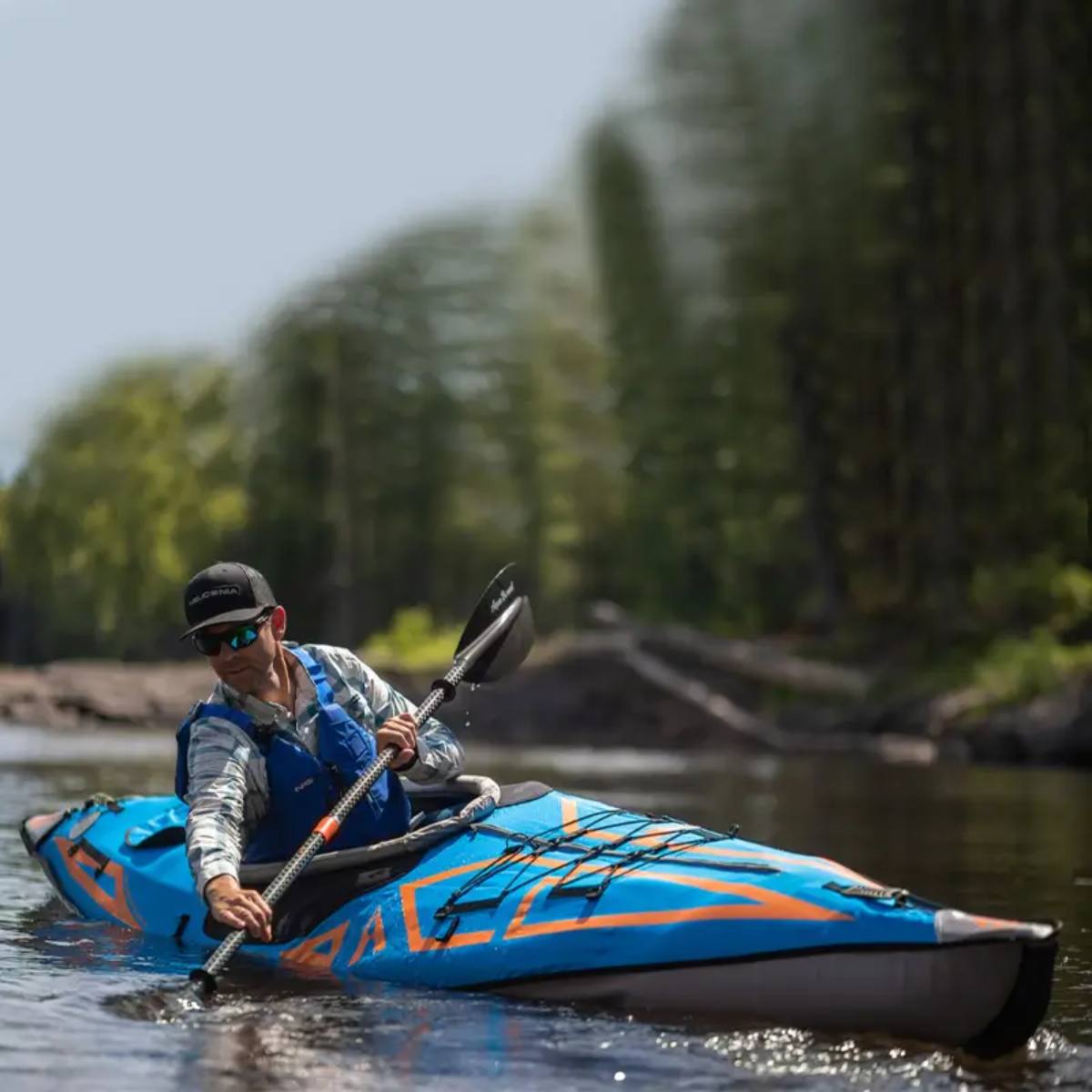
The short answer: yes, quality inflatable kayaks can be worth the money. The image of a round, floppy craft drifting sideways at the first hint of wind is outdated for many current designs. Shaped bows, high-pressure floors, fins and better hull construction have changed how a good inflatable feels under a paddle.
But there is no magic material. A cheap beach toy and a carefully designed touring inflatable are different products. A specialist sea kayak or surfski still has advantages when speed and demanding conditions matter. I sell inflatables at Kayak & SUP because for many people the best kayak is the one they can store, transport, set up and actually use. I also want you to know the compromises before you buy.
01 / THE EVOLUTION
From awkward inflatables to purposeful hulls
Older recreational inflatables earned some of their reputation. Broad, rounded side tubes and soft floors can create a lot of drag and windage. If the bow has little shape and there is no fin or keel to resist sideways movement, keeping a straight line takes more correction strokes. That experience is real, but it does not describe every kayak made of air.
Look at the design details instead of the label. Advanced Elements uses aluminium ribs in the bow and stern of its AdvancedFrame family to shape those ends; its Elite models add a firmer drop-stitch floor. Jaspara Quest models use a drop-stitch floor and twin keel features, while a fin can further improve tracking. Full drop-stitch designs use internal threads to let flat chambers hold higher pressure. These choices help a boat keep its intended shape when loaded and moving through water. They do not make all inflatables identical, and they do not remove the need for correct inflation.
Better materials matter too. Many specialist boats use reinforced layers, protective outer covers or replaceable components, with construction varying by model. Multiple chambers can provide redundancy, but you should still inspect the hull, avoid sharp hazards and carry the repair items specified by the manufacturer. The useful question is no longer simply “inflatable or hard shell?” It is “which hull, which floor, which paddler and which conditions?”

02 / MYTH VERSUS REALITY
Five claims I hear in the showroom
“They are just pool toys.”
A pool toy is not built or specified like a specialist kayak. On an AdvancedFrame Elite, for example, a shaped bow and stern, separate chambers, a fitted seat and drop-stitch floor are part of a deliberate paddling design. On a Jaspara Quest Solo, the floor and hull features similarly serve a purpose. Check the actual model, its intended waters, load limits and build. An inflatable label alone tells you too little.
“They all paddle slowly and zigzag.”
Length, width, waterline, stiffness, fin or skeg and paddler technique all affect pace and tracking. Australian distributor Oz Inflatable Kayaks says some AdvancedFrame Elite models can hold a recreational cruising pace alongside recreational rigid kayaks; that is a distributor assessment, not an independent speed test and not a claim about every inflatable. A long specialist hard shell can still be faster, especially in a sprint.
“A breeze will blow them anywhere.”
Wind affects every kayak. Higher sides can give the wind more to push against, so some inflatables need more attention than a lower-profile sit-in design. Check the forecast, launch where conditions suit your ability and be willing to change plans. A fin helps tracking, but it does not cancel weather. The Queensland maritime safety advice is worth checking before each outing.
“One puncture means the end.”
Specialist inflatables are built for real use, but they are not puncture-proof. Layered protection and more than one chamber can buy time, while a patch or replaceable tube may be possible for certain damage. Read your model’s instructions, inspect for wear and carry the right repair kit. A major leak far from shore remains serious: stay within conditions and distance you can manage safely.
“Inflation and cleanup ruin the day.”
There is a setup and pack-down routine. The Australian distributor describes a broad roughly 4–15 minute range for manual setup across different boats, before you count preparation, accessories and your own pace. Some PVC surfaces wipe down faster; fabric-covered boats ask for more thorough drying. An electric pump can reduce effort if compatible. The trade is that you may avoid roof racks, a long hull in the garage and awkward loading at each end of the trip.
03 / ON THE WATER
Can an inflatable match a hard-shell kayak?
In the right comparison, it can come surprisingly close. A well-designed, correctly inflated recreational model can offer satisfying glide, a defined line through the water and a stable platform. The best examples narrow the gap with ordinary recreational hard shells. That does not mean all models achieve the same speed or that a compact inflatable replaces a long sea kayak, racing boat or specialist craft.
For a fair test, compare kayaks intended for the same paddling. Put a short, wide recreational inflatable against a short, wide recreational rigid boat. Then compare an Expedition Elite with a touring-oriented recreational boat. The length, shape, load and paddler technique matter as much as the material. A slightly underinflated floor, dragging fin or poor paddle fit can make any theoretical performance claim feel irrelevant on the day.
There are also waters where I would choose a different tool. Strong wind, exposed crossings, surf or a long speed-focused journey raise demands that a casual outing does not. An inflatable must be rated and set up for the conditions, and a paddler must have the skills. The honest promise is capable, enjoyable performance for suitable recreational use, not universal parity with every rigid kayak.
That is exactly why an on-water demo is valuable. You can feel the difference between a roomy Quest, a more sheltered AdvancedFrame and a longer Expedition rather than buying a headline.
04 / THE REAL VALUE
Are inflatable kayaks worth it for your lifestyle?
When someone asks if inflatable kayaks are worth it, I ask what the boat will change in their life. Do you have a garage or secure side access? Can you lift a full-size rigid kayak onto a roof rack and unload it at the destination? Can you store it out of the sun? How many times would you paddle if every trip required another person or a long loading routine?
Are inflatable kayaks worth it for someone with limited space? A bagged kayak can make spontaneous local paddles and a small-home lifestyle far more realistic. In a growing area, apartments, townhouses and shared garages make the storage question practical rather than theoretical. For travellers it can put a kayak into a car boot or caravan compartment instead of on a roof. For someone handling the whole trip themselves, it can turn “I need help loading” into “I can go today.” That freedom has value, even though you still need room for the full bag, paddle, pump and lifejacket.
Run the full cost, not just the sale price. Consider paddle and PFD, a compatible pump, replacement parts, care and any roof-rack alternative. Look at the packed full-kit weight as well as the assembled weight. The AdvancedFrame Ultralite is about 8.46 kg assembled and 9.42 kg as a full kit, but it has a recommended paddler fit limit. A more spacious or feature-rich boat can be considerably heavier. “Inflatable” does not automatically mean featherweight or cheaper than a hard shell.
Good ownership also includes drying. Rinse salt and grit, dry thoroughly before extended storage and keep the boat in a cool, dry place away from prolonged sun. If you pack it wet to get home, open and dry it there. The manufacturer’s care guidance and Australian distributor’s care advice are useful companions to your own model manual.
05 / WHO IT SUITS
Choose the boat that removes your particular obstacle
Limited storage
A packed kayak can live where a full hull cannot. Measure the bag, drying space and accessories before buying.
Independent loading
Avoiding a roof lift can be transformative. Compare the full-kit weight and how far you must carry it.
Travel and variety
A portable kayak can come along more often, provided the model suits the water at your destination.
If your priority is an open, practical setup with room to move, explore our Jaspara guide. If you want a refined sit-in feel and shaped AdvancedFrame bow, read the Advanced Elements guide. Neither brand has a single “best” boat for everyone; fit and intended use decide it.
On the other hand, if you have generous storage, easy roof-rack handling and want a boat optimised for a specific demanding discipline, a rigid kayak may be the better purchase. I would rather help you choose that than insist a portable boat solves every problem.
Bonus / THE BUYING TEST
A practical checklist before spending money
When you compare boats online, write down your real trip from start to finish. Where will the packed bag live? How far is the carry from car to launch? Where will you inflate it without blocking a busy ramp? Will you be able to rinse and dry it when you get home? This simple exercise often exposes a mismatch before you pay for it.
Measure the whole kit. Product pages may lead with an assembled hull weight, but you carry the bag, pump and sometimes a seat, fin and accessories. A long touring inflatable can weigh much more than a compact solo boat. A smaller bag is attractive only when the cockpit and capacity also fit you and your gear.
Ask what gives the hull its shape. A drop-stitch floor, aluminium-rib ends, fin or skeg can change how a model behaves, but they do different jobs. The firmer floor does not replace good hull shape; a fin improves directional stability but is not a cure for strong wind. Inflation pressure matters. Follow the model’s gauge and valve instructions rather than guessing by hand.
Decide what “performance” means to you. Is it a straight line on a calm lake, keeping a comfortable touring rhythm, carrying a child or dog, or paddling in sheltered bays? That answer will narrow your search more than a dramatic top-speed claim. If you are comparing a tandem to a solo or a 3-metre boat to a 4-metre one, you are comparing different purposes.
Put the safety kit on the list. In Queensland the lifejacket requirement depends on the vessel and water. Check current rules and fit, carry communication suitable for the location, tell someone the plan and watch the forecast. A boat that fits in a bag is still a boat, with real decisions to make before launching.
The result is a fair answer to “are inflatable kayaks worth it?” for your situation. If the bag, fit, routine and water all make sense, a specialist inflatable may earn its place quickly. If any of those points fail, choose a different model or a hard shell. Either way, you have learned something useful before the first paddle.
What a good inflatable still asks of you
Be particularly careful of the gap between marketing photographs and a normal Tuesday paddle. A kayak shown packed into a neat bag still needs enough clean space to unfold, inflate and attach its seat and fin. On the return trip, sand and salt collect around valves and seams. Some fabric-covered kayaks have layers that take longer to dry than a simple PVC surface. Pack wet only for the journey home, then open it and dry it before storage.
Temperature deserves attention too. Air pressure changes as the boat warms or cools. Check the manual and pressure gauge, especially when a kayak sits in direct sun after inflation. Do not leave it fully inflated in a hot car, and do not assume the same pressure is right for every chamber. The correct routine is model-specific, and a compatible pump with a gauge makes that easier to manage.
Finally, learn what the warranty, parts and repair process look like before you need them. A minor puncture may be patchable; damage to a seam, valve or covered tube can be a different job. Ask whether a replacement part exists and how to diagnose a slow leak. These are ownership questions, not reasons to dismiss a whole category. Rigid kayaks also need care and can be damaged. The better purchase is the one whose maintenance fits your life.
06 / QUESTIONS WORTH ASKING
Inflatable kayak FAQs
Are inflatable kayaks worth it if you value easy transport as much as time on the water? These answers help you check the practical details.
Are inflatable kayaks reliable for regular use?
A quality model maintained as instructed can be a reliable recreational boat. Inspect valves and hull, use the specified pressure, rinse and dry after trips, and deal with wear early. Reliability depends on the construction and care of the particular boat, not the word “inflatable” on the label. Carry the manufacturer-recommended repair kit and stay within appropriate waters.
Do inflatable kayaks track straight?
Some track very well for recreational paddling. Shaped hull ends, a firm floor, keel features and a fin or skeg can help; hull length and load matter too. A broad high-sided boat in wind will feel different from a lower-profile sit-in model. Try the exact boat with your paddling style if tracking is a deciding factor.
Are they safe in the ocean?
There is no single answer for all inflatables or all ocean conditions. Use a model rated for the water, know its limitations and your own, check weather and tides, wear the correct lifejacket and follow local rules. Sheltered coastal water on a mild day is different from surf, strong wind or an exposed crossing. If in doubt, choose a more sheltered route or postpone.
Will an inflatable replace my hard-shell kayak?
It might, if your paddles are mainly recreational and storage or transport is the reason you go less often. It might be a useful second boat if you still want a specialised rigid kayak for other trips. Compare what you actually do on the water and the effort before and after it, not only the top speed on a calm day.
What is the best first test?
Sit in the cockpit, lift the packed bag, inflate it to the specified pressure and paddle in suitable conditions. Notice entry, seat support, tracking, windage and how easy it is to pack. An honest test often settles the “worth it” question far better than a generic ranking.
READY FOR YOUR OWN TEST?
Try the difference, then decide.
Tell me how you paddle, how far you carry the bag and what you want to change about your current setup. We can compare the models and, where possible, put you in one on Sunshine Coast water.
KEEP EXPLORING
The inflatable kayak guide series
Technical context: Advanced Elements innovations, Australian drop-stitch guide and general inflatable kayak questions. Manufacturer and distributor performance statements are model-specific; compare current specifications before ordering.